 |
| Marilyn rinsing her feet after a dip in the Gulf waters |
Well it's been a busy couple of weeks for the wandering Beringers. Last time I posted we had arrived in Roberstville Alabama. Azalea Acres turned out to be a perfect place to commute to the sights of Mobile. The owners have done a really nice job of maintaining this park. They are to be commended. Or first sightseeing outing was the USS Alabama, a WWII battleship. This is one of eight still around. All have been decommissioned and are now museum ships. The Alabama is berthed in Mobile.
 |
| An F4 Phantom marking the entrance to the park |
The Alabama saw action in both the Atlantic and Pacific theatres. Walking through the ship was an experience in living history. My father served in the Pacific aboard a destroyer (tin can) as a radio officer and I can remember him talking about the cramped spaces and less than appealing food. As we passed through the carefully restored spaces, it occurred to me that the men who served on this ship were in their 20's for the most part. They grew up fast here aboard this ship. We who are one generation removed from those days can't imagine what they went through during that time of war but we have the obligation to remember and pass along what the "Greatest Generation" did for us.
 |
| One of the four screws from the ship |
 |
| A view of the galley |
 |
| Berthing for crewmen |
 |
| One of the three 16 inch gun turrets. They were protected by 18 inches of steel on the circumference |
 |
| Barbershop |
 |
| Print shop |
 |
| No privacy here!! |
 |
| One of four boilers. Steam was pressurized to 600 psi to turn the turbines |
 |
| Sick bay |
 |
| Looking aft from the foc'sle |
 |
| One of the several 20mm anti aircraft guns |
 |
| The coils inside this room were massive |
 |
| The ship's brig |
I felt a heavy sense of history in this ship. I'm a WWII history buff and being here gave me a chance to really experience the actuality of shipboard life. In the late sixties and early seventies, I served aboard three NOAA ships as an oceanographic survey technician. There was something very familiar about being aboard the Alabama that gave me a special feeling of camaraderie with the men who served on this battleship. I was reluctant to leave.

On a lighter note, Mobile is the home of the original Mardis Gras, a fact neither of us were aware of. Though most people associate Mardi Gras with New Orleans, Mobile began holding the festival in 1703, 15 years before it started in Louisiana. Based on a French Catholic tradition, the celebration is now a city-wide holiday in Mobile, where even schools close down to celebrate. The first masked ball in Mobile began in 1704, and the tradition of a parade started in 1711. The first float was a cart sporting a papier-mache cow's head. The parade has evolved into something quite spectacular, featuring elaborate floats and costumes. Mobile had been the original capital city of the French Louisiana territory, but its location made locals wary of destruction by hurricane. The capital was then moved to New Orleans in 1718, and the celebration followed. The elaborate costumes worn by the kings and queens (there are two, African American and Caucasian) are beyond outrageous.


 |
| Photo comes from mobilemask.com |
The event covers two weeks in February and revelers hold many parades and balls. Our tour guide made it plain that Mobile's Mardi Gras is kid friendly and outrageous behavior is not tolerated. The photos below were taken from those available on mobilemask.com
We broke camp on the 28th and moved to the New Orleans area to an RV park called Lake Pontchartrain Landing. It was conveniently located close to the city and proved to be a 5 star resort...with a 5 star fee I might add! From here we could drive to a parking lot near the French Quarter and use the trolleys to explore the city. A one day pass was only $3.00 a head. History is always a good start so we took the Cemetery Tour #1 which is owned by the New Orleans Catholic archdiocese.
(from Cities of the Dead)
The above-ground tombs in New Orleans cemeteries are often referred to as "cities of the dead." Enter the cemetery gates, and you will be greeted by rusty decorative ironwork and blinded by sun-bleached tombs. Crosses and statues jutting from tomb surfaces cast contrasting shadows, adding to the sense of mystery. Votive candles line tombs on holidays, reminding you that the dead have living relatives who still care.
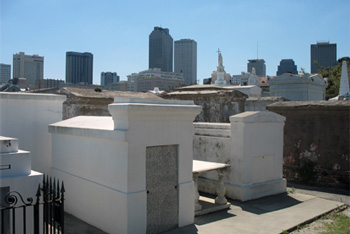
New Orleans has always respected its dead, but this isn't the reason that our departed loved ones are interred above ground. Early settlers in the area struggled with different methods to bury the dead. Burial plots are shallow in New Orleans because the water table is very high. Dig a few feet down, and the grave becomes soggy, filling with water. The casket will literally float. You just can't keep a good person down! The early settlers tried placing stones in and on top of coffins to weigh them down and keep them underground. Unfortunately, after a rainstorm, the rising water table would literally pop the airtight coffins out of the ground. To this day, unpredictable flooding still lifts the occasional coffin out of the ground in areas above the water table, generally considered safe from flooding.
Another method was to bore holes in the coffins. This method also proved to be unsuitable. Eventually, New Orleans' graves were kept aboveground, following the Spanish custom of using vaults. The walls of some cemeteries here are made of economical vaults stacked on top of one another, while wealthier families could afford the larger, ornate tombs with crypts. Many family tombs look like miniature houses, complete with iron fences. The rows of tombs resemble streets--and this is why New Orleans burial plots quickly became known as cities of the dead.
Our tour guide led us through the maze of vaults explaining many of the unique ways in which the dead are interred. New Orleans has an ordinance which forbids interring another coffin into a vault until two years have passed. Once this period has elapsed, the forgoing coffin is removed and the remains are placed in a bag and pushed to the far end of the vault and another coffin is inserted.
 |
| This tomb is owned by Nicholas Cage |
 |
| An Italian family tomb whose records have been lost. No one knows who it belongs to or who is buried inside |
New Orleans, being a traditionally Catholic city, has a history of discrimination between Catholic cemeteries and Protestant cemeteries. In this particular one, there is a section off to the side reserved for Protestants.
Next we took the Canal Street trolley to Carrollton St. and walked the rest of the way to City Park.
 |
| On Allard Blvd we saw many beautiful oak trees |
 |
| Entering into the park we were greeted by oak trees covered with Spanish moss |
 |
| Perfect reflection of a small stone bridge |
We heard some jazz in the distance and walked toward it. Only in New Orleans would you find a jazz band playing for donations.
A quartet playing just for fun, and a few quarters
In the park there is the art museum (it was closed on the Monday we were there) and a section devoted to sculptures from artists all over the world
 |
| See photo below |
There were many interesting art pieces some of which were frankly bizarre like this one titled "Monkeys"
 |
| Perhaps referring to the theory of evolution? |
Here's one called "Spider"
 |
| Necklaces in the trees |
From the park we took the trolley back to the French Quarter and spent some time at the St. Louis Cathedral and Jackson Square. The magnificent façade of the cathedral was well, magnificent.
And who could blame us if we wanted a selfie in front of Andrew Jackson's memorial?
If you remember your US history it was
in the War of 1812, where he won decisive victories over the Indians and then over the main British invasion army at the Battle of New Orleans.
What with all this sightseeing and walking, wouldn't you suppose we'd want a good meal? Yep and in n'wOlins you eat southern. After perusing the reviews of local restaurants (on our phones of course) we choose Ralph and Kacoos on Toulouse St.
 |
| Behind our table was this full size alligator which thankfully never made a move toward us |
And who could not stroll down Bourbon St while in New Orleans? Well we didn't but after dinner I walked the two blocks and can at least say I was there!
 |
| Playing his harmonica for donations |
The next day we drove to one of the few remaining plantations which have a complete history. It was the Laura Plantation along the Mississippi River. It is a Creole based sugar plantation. Ever wonder what the word Creole means? I did and here is a description from the Laura Plantation website.
Creole is the non-Anglo-Saxon culture and lifestyle that flourished in Louisiana before it became a part of the United States in 1803.
Louisiana Creole is a blending of three different ethnic influences: the west European, west African, and includes a significant input from the Native American.
The Creole functioned in an elitist structure, based on family ties. In its philosophy, economics and politics, European custom and modern thought were thrown out and, in their place, a strict, self-serving pragmatism was born out of the isolation and desperation that characterized Louisiana in her formative years. The earliest, tragic lessons of survival in Louisiana created a family-oriented world that would, for centuries, put little value in public education or public works and even in the rule of law.
Creole Louisiana was a place where class, not race, determined social status, where rural life conformed to rigid disciplines, where human bondage created wealth, where adherence to the family business and tradition was paramount, where women ran businesses and owned property, where democratic ideals and individualism were held in contempt and where, until the 20th century, people spoke French and lived this way, separate from the dominant White-Anglo-Saxon-Protestant American culture.
The Creole experience in Louisiana is a close cousin to Creole cultures world-wide. The nearest examples are found in the Caribbean: Cuba, Haiti, Guadeloupe and Martinique. The Indian Ocean holds: Réunion, Mauritius, Seychelles and Goa. In South America, the Guianas and Brazil are recognized as Creole countries.
 |
| Guilliaume Duparc and Nanette Prud'Homme the original owners of the plantation. |
Guillaume Duparc's sugar farming complex was originally called l'habitation Duparc, then, years later, renamed the Laura Plantation. At its largest size, it was approximately 12,000 acres, which included properties amassed over time. In 1804, Duparc, a French naval veteran of the American Revolution, acquired the property.
Duparc also acquired adjacent parcels from Acadians who had settled the land 20 years prior. Duparc's new farm was located on prime real estate, on unusually high and cleared ground. He placed his manor house squarely in the middle of the large Colapissa Indian village that had been on-site for over a century.
Construction of Duparc's manor house began in 1804 and completed 11 months later. The work was executed by highly-skilled slaves, probably of Senegalese descent, in pre-fabricated methods, typical of early Louisiana vernacular structures. This "maison principale" was raised high above ground, resting on blue-gray glazed brick columns and walls, supported underground by an 8-foot deep pyramidal brick foundation. The cypress superstructure was inlaid with locally fired brick (briquette-entre-pôteau), plastered inside and stuccoed outside, with a brightly painted (red, ochre, green and pearl) exterior. This U-shaped structure totaled approx. 24,000 sq. ft. and had a 2,500 sq. ft. detached kitchen to its rear. At Duparc's death in 1808, the l'habitation consisted of 10 sizable buildings, including quarters for 17 slaves, a barn, warehouses and a small, rudimentary sugar mill.
Some 600 feet north of the manor house flowed the Mississippi. A wooden pier allowed docking for boats of all sizes. Along the riverbank, ran a 4-5 foot-high levée that afforded protection from spring flooding. A primitive road followed the levée and a tall fence separated the plantation from passersby. Inside the fence were planted 2 large orchards of pecan trees that parted to create an allée, where one could see the manor house from the river and, more importantly, funnel the river's breezes directly into the house.
24,000 sq. ft. and had a 2,500 sq. ft. detached kitchen to its rear. At Duparc's death in 1808, the l'habitation consisted of 10 sizable buildings, including quarters for 17 slaves, a barn, warehouses and a small, rudimentary sugar mill.
Some 600 feet north of the manor house flowed the Mississippi. A wooden pier allowed docking for boats of all sizes. Along the riverbank, ran a 4-5 foot-high levée that afforded protection from spring flooding. A primitive road followed the levée and a tall fence separated the plantation from passersby. Inside the fence were planted 2 large orchards of pecan trees that parted to create an allée, where one could see the manor house from the river and, more importantly, funnel the river's breezes directly into the house.
 The house, surrounded by a high fence, served not only as office headquarters for business but as the site for all manner of social entertainment. The whole of the plantation was painted in a color code of ochre, red, green, mauve and gray, the same colors found on the manor house.
 Approx. 400 ft. behind the house was a road, going south, perpendicular to the river, lined on both sides with slave cabins, facing the road and stretching a distance of 3.5 miles. This was always referred to as the "back" of the plantation, where enslaved laborers resided, distant from the area nearer the river, called the "front" and separated from the front by a high fence and muddy swale than ran parallel to the river. Each slave cabin held two families and each had a chicken house and/or pigpen and vegetable garden just outside the cabin.
In the decades before the Civil War, the slave quarters consisted of 69 cabins, communal kitchens, a slave infirmary, and several water wells stationed along the same road. One mile behind the manor house stood the sugarmill. The mill was surrounded, as everything else on the farm, by sugarcane fields. By the 1850s, the Duparc Plantation was the workplace for 100 mules and 195 humans, 175 of them slaves.
Approx. 400 ft. behind the house was a road, going south, perpendicular to the river, lined on both sides with slave cabins, facing the road and stretching a distance of 3.5 miles. This was always referred to as the "back" of the plantation, where enslaved laborers resided, distant from the area nearer the river, called the "front" and separated from the front by a high fence and muddy swale than ran parallel to the river. Each slave cabin held two families and each had a chicken house and/or pigpen and vegetable garden just outside the cabin.
In the decades before the Civil War, the slave quarters consisted of 69 cabins, communal kitchens, a slave infirmary, and several water wells stationed along the same road. One mile behind the manor house stood the sugarmill. The mill was surrounded, as everything else on the farm, by sugarcane fields. By the 1850s, the Duparc Plantation was the workplace for 100 mules and 195 humans, 175 of them slaves.
These clay urns were originally buried such that only the lip was above ground. Into them they placed milk, eggs, butter and anything else that would spoil in the hot, humid climate. The ground was far cooler that the surrounding atmosphere
These doors on the front porch were designed solely for the purpose of doing business. There are fours rooms. Two rooms on the left for male businessmen and two on the right for female businesswomen. (that's redundant I know). Anyway, the tour guide pointed out that the plantation was a business and a serious one at that.
 |
| Where the business was carried out |
 |
| The other rooms in these photos have been restored but this room was left as it was originally constructed. It is the preparation room where food was brought in from the kitchen out back and prepared for delivery to the family in the dining room |
 |
| Here are two of the six remaining slave cabins |
 |
| A slave cabin that has been restored to its original specifications |
 |
| In the gift shop next to Madame Laura |
So much is known about this plantation because Laura wrote the history and published it. Additionally, records of the plantation were found in St. Louis where she spent the rest of her life after selling the plantation in the late 19th century.
After New Orleans we moved north into Mississippi to Coldwater where we visited rock and roll and Elvis in nearby Memphis TN. I'll post more in a few days.


